After a little over 5 months and 407 commits since NetworkManager 1.56, the new release is ready: NetworkManager 1.58.
Let’s take a look at the most interesting parts!
A wave of nmtui improvements
This release brings a batch of usability work to nmtui, the text user interface.
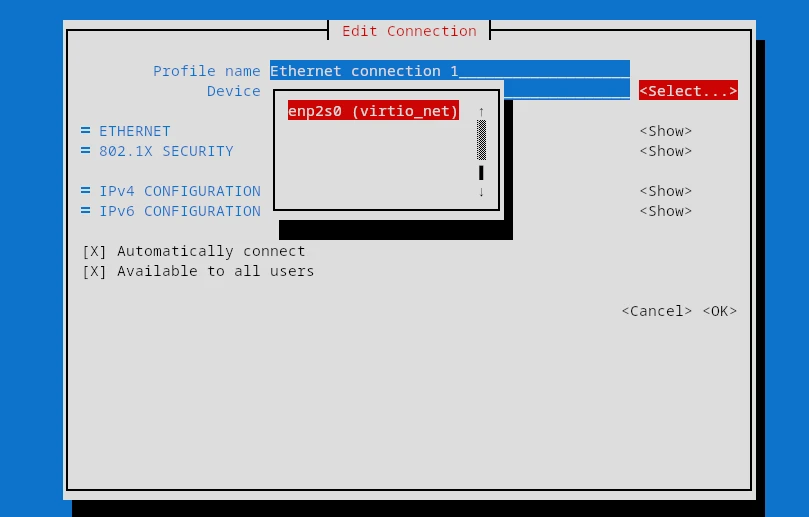
When creating a profile for a physical interface (Ethernet, Wi-Fi, and so on),
a new <Select...> button lets you pick from the available devices instead of
typing the interface name by hand.
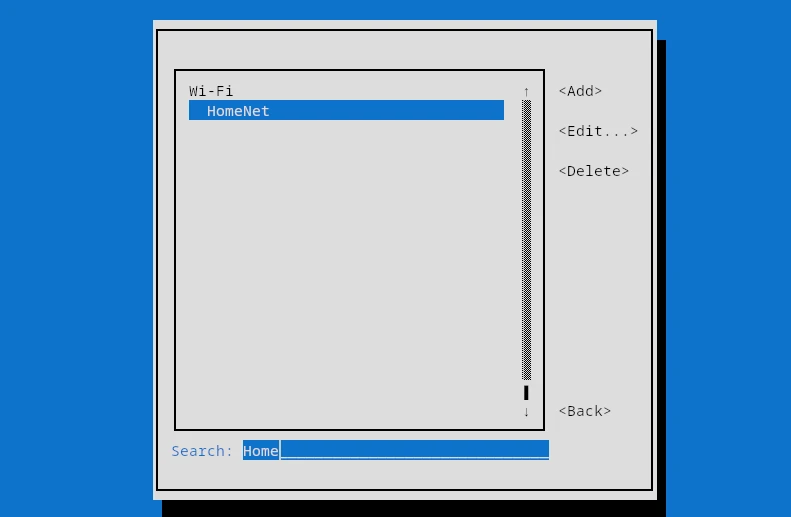
The connection lists in nmtui connect and nmtui edit now support a vim-style
/ search that filters the list to matching entries as you type.
The “Activate a connection” screen gained a “Rescan Wi-Fi” button that scans for nearby networks on demand, and the secret prompt shown when activating a connection now has a “Show password” checkbox, matching the connection editor.
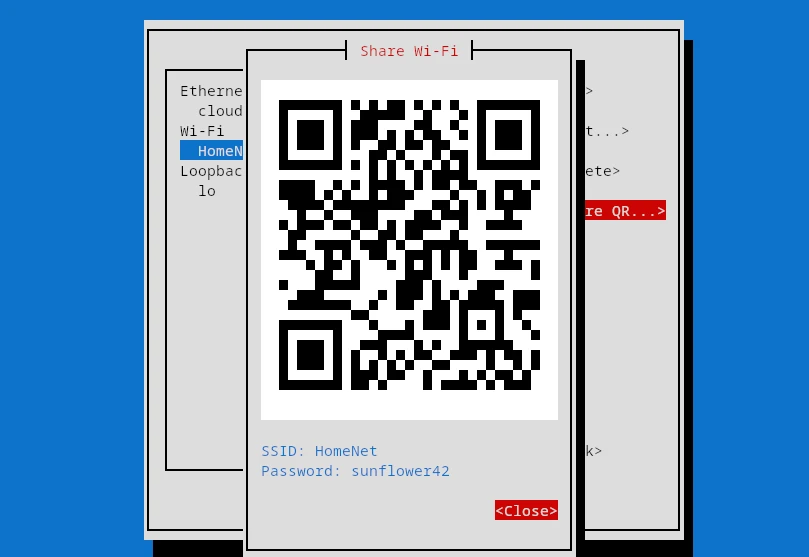
You can also share a Wi-Fi network as a QR code straight from nmtui: the new
“Share QR…” button in “Edit a connection” mirrors nmcli device wifi show-password.
Finally, configuring bonds is more complete thanks to a new “other options” field that covers bond options without a dedicated input, and nmtui forms now redraw when the terminal is resized instead of staying clipped or off-center until you reopen them.
IPv6-only networks: CLAT (464XLAT)
Continuing the march towards IPv6-only networks, NetworkManager now supports CLAT (464XLAT), implemented with a BPF program. CLAT lets an IPv6-only host reach IPv4-only destinations.
To go with it, the default of the ipv4.dhcp-ipv6-only-preferred property
changed to a new auto value, which automatically enables the option when CLAT
is enabled (yes or auto) in the connection profile.
GENEVE tunnels
NetworkManager can now create and manage GENEVE (Generic Network Virtualization Encapsulation) interfaces.
Wi-Fi updates
Several Wi-Fi improvements landed in this release:
- The
bandproperty of Wi-Fi connections now accepts the6GHzvalue. - nmcli scan results now show each access point’s Wi-Fi band.
- The
powersaveproperty now works with the iwd backend. - WPS credentials with a 64 hex-character PSK are now accepted, which some access points return.
- wpa-psk connections respect
connection.auth-retryand only prompt for new secrets on the last authentication attempt before failing.
Persisting device managed state
The managed state of a device can now be persisted across reboots via nmcli and the D-Bus API. On top of that, you can change the device’s administrative state in the kernel at the same time as the managed state.
Security hardening
This release fixes two vulnerabilities and tightens several defaults:
- CVE-2026-10805: hostnames and MUD URLs are now validated before being written to the dhclient configuration file, rejecting characters that could alter the config syntax.
- Fixed an out-of-bounds read in the internal DHCPv4 client that an on-link attacker could trigger with a malformed UDP packet, crashing NetworkManager.
- Support for Wireless Extensions is deprecated and is now disabled by default. It will be removed in a future release.
- For private connections (those that set a user in
connection.permissions), NetworkManager now verifies that the user can access the 802.1X certificates and keys referenced by the connection. A new libnm function lets VPN plugins perform the same check. - Removed the
modify_systembuild option, which set up polkit permissions allowing non-admin users to create system-wide connections. That configuration is discouraged because it can be used to bypass filesystem permissions. - Dropped support for dhclient as a DHCP backend, which had been deprecated since NetworkManager 1.50.
What else?
- The connectivity check now uses only the DNS servers defined on the same link,
falling back to any available server if the link has none. A new
check-connectivityconfiguration option can disable the check for selected interfaces, and a bug that left stale global connectivity state was fixed. - NetworkManager uses an internal ping implementation when
connection.gateway-ping-timeoutorconnection.ip-ping-addressesare set, instead of relying on thepingtool. - The systemd units in the initramfs are now installed via a systemd generator.
- The internal DHCPv4 client ignores option 3 (Router) when the lease contains option 121 (Classless Static Route), as recommended by RFC 3442.
- IPv6 interfaces that receive a prefix via DHCPv6 prefix delegation are now
considered healthy without a non-temporary address, and the delegated prefix
can be used on an interface configured with
ipv6.method=shared. - reapply now honors the
ipv6.ignore-auto-dns,ipv6.ignore-auto-routesandipv6.never-defaultproperties even when DHCPv6 is not restarted, so DHCPv6-provided DNS and routes are correctly suppressed without a connection restart. - Connection profiles with manual IP addressing and gateways that are not directly reachable now warn on activation and when added or modified via nmcli and nmtui. On-link routes are still added automatically for now, but that will change in the future; add addresses or routes whose subnets cover these gateways to fix the warning.
- The versioning scheme is unified to use the
-rcXand-devsuffixes everywhere they apply, including the release tarball URL and filename and the version reported by nmcli and the daemon. The C API keeps the 90+ scheme for RC versions.
Acknowledgements
Many thanks to all contributors who provided feedback, ideas or patches.
Anders Jonsson, Andrej Kozemcak, Antonio Alvarez Feijoo, Baurzhan Muftakhidinov, Ben Hagen, Beniamino Galvani, Cédric Bellegarde, Christian Krause, Daniel Nylander, David Ward, Federico Ton, filmsi, François Horta, Gris Ge, Günther Noack, Hiroyuki Yasuhara, Íñigo Huguet, Jan Fooken, Jan Vaclav, Josephine Pfeiffer, Leon M. Busch-George, Lubomir Rintel, Marko M. Kostić, Mary Strodl, Matthieu Baerts, Mattia Dal Ben, Mitchell Augustin, Muhammet Kara, Paul Menzel, Popax21, Pradyumn Rahar, Rafael Fontenelle, Rahul Rajesh, Rishabh Garg, Robert Schlabbach, Thomas Makin, Till Maas, Tim Spriggs, twlvnn, Vicki Pfau, Vladimír Beneš and Vladislav Tsisyk.
Also thanks to our Quality Engineers from Red Hat for all the testing: Vladimír Beneš, Filip Pokryvka and Mingyu Shi.
Join us on our GitLab project.
Get the new release
As usual, the next release of your favorite Linux distribution will surely ship the new version.
In case you’re too impatient to wait, or you are, in fact, responsible for keeping NetworkManager up to date in a distribution, get the tarball from our download page.
Thanks for tuning in and goodbye!